the dreams available in the black of the earth
a track between stations / the allegories of the caves made of concrete
good morning ~
(click the link / osprey nest to listen)

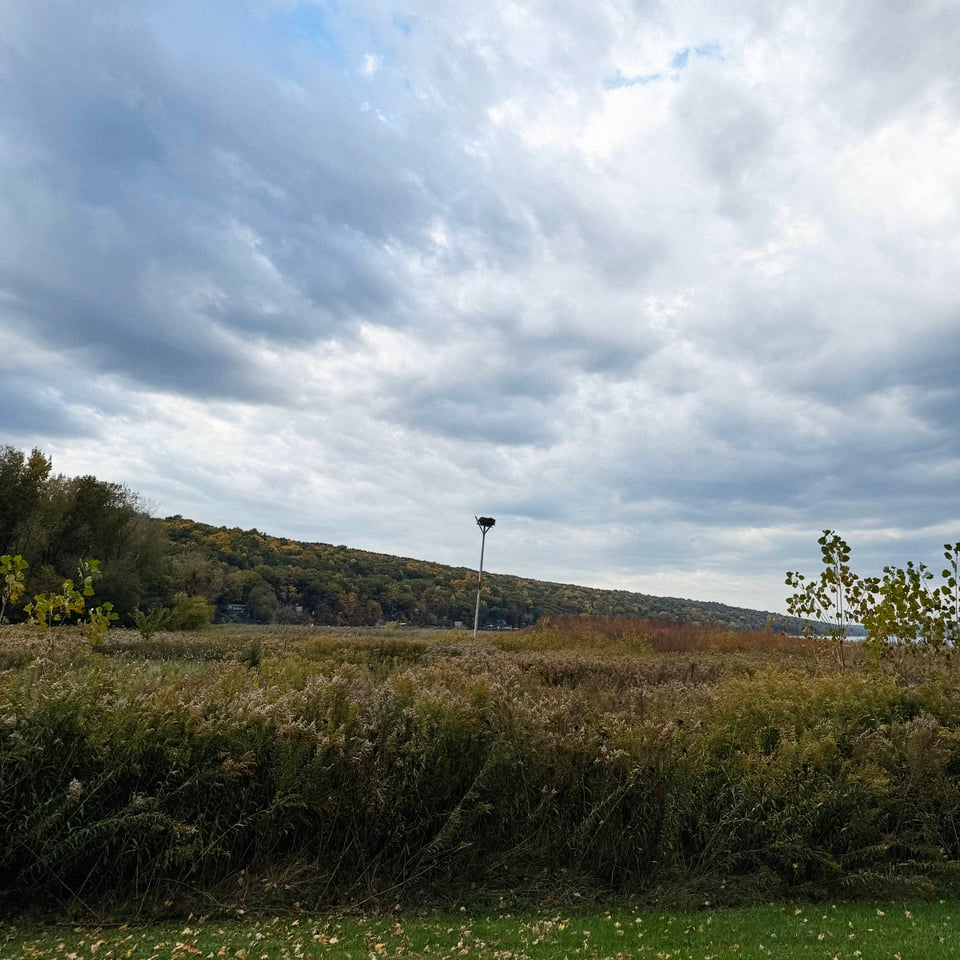
today’s track collapsed and folded in on itself, increasingly that’s an essential part of my process
I’m really excited to hear the whole Skee Mask x North Americans album that’s coming out in a couple of weeks, this megamix preview is really great
Also remembered recently this awesome collection of heavenly 90s breakbeat, enjoy that
here’s some interesting historical perspective from the Paris Review if you’re interested in reading more about mid-century urban renewal practices
Don't underestimate the power of time to erase, he said. Much of life, and what matters most to a culture, consists of what a visual artist would deem 'fragile materials': wood, say, and wax. Feathers, flowers, fish bones. Plants and unstable pigments. Ice. Emotions, and their transmission from one person to another. Blood, tears, tenderness, joy. Very little of what comprises culture can be found at a dig site. Stone can be found. And this...is the level of logic we are dealing with: the stones are all that is left, and so let's call them stone age.
-Rachel Kushner, writing in Creation Lake
In the middle of the 20th century in New York State they went kinda cuckoo kicking people out of their homes, bulldozing perfectly good neighborhoods, and erecting these gigantic temples of culture or these wildly disruptive highways. Lincoln Center came about this way, burying the history of Manhattan's west side under concert halls and opera houses that kind of seem like they've always been there. The central fountain and the Chagall tapestries that hang inside the Metropolitan Opera have this timeless, beamed-in quality, but they only seem that way. In truth many people's lives were permanently disrupted. And ironically West Side Story - itself a great and beloved artifact of culture, one that's probably been realized in some way many times over at Lincoln Center - is itself an artifact of that erased neighborhood.
One Rockefeller built Lincoln Center and another built the Empire State Plaza, an even grander spread of slabs in the state capital that blends seamlessly into 787, a highway that notoriously cuts off Albany from its Hudson River waterfront. Hard not to read brotherly competition or family pride into these jumbo construction projects, a little oneupmanship? The Plaza is primarily a place where government happens in a multi-decade mishmash of architectural styles. The lobbies where the lobbyists lobby are there, the restaurants where state reps and MTA officials take lunch meetings are nearby. And the Egg is perhaps its crown jewel, perched magnificently and a little perilously near the sheer stone wall. An ovoid building with 52" thick walls that houses a delightfully retro-futuristic performing arts center.
I have worked at both of these institutions. My first job after college was a brief stint doing telemarketing for the Met Opera, a gig I was not hardcore enough to handle in the long run - I was not a closer. But then I got a job at the Lincoln Center movie theater and my stint there lasted eight years. We were deep in the concrete, the theaters where I most often worked were refurbished from a former parking garage and the screening rooms themselves were way down deep in the bowels.
Now many years later I am contributing - arguably far more meaningfully - to another historically notable concrete structure dedicated to the arts.
Let's say a modern seafront village gets washed away by a tsunami...leaving crumbling concrete and twisted rebar as the only traces of the people who had been living there. The anthropologists come along, and they examine the remains of this tsunami-destroyed community and conclude that there had once flourished, in this washed-away place, a culture whose religious idols were concrete and rebar.
I got deep into John Wilson's TV show in the middle of COVID lockdown - I suspect many of you did as well. I watched it because I missed living in New York City, missed the abundance of its people's eccentricities. So it was really surprising to me when the Egg popped up in season two - hey, that thing is right off the highway from here. Wilson goes into how he attended an a cappella event there hosted by NXIVM, the infamous Capital Region cult founded by RPI graduate Keith Raniere (a very not-in-the-bible sentence). So of course when I saw that his upcoming feature film was going to be called "the History of Concrete" I immediately reached out to the film studio to see if we could organize a screening, all weirdly perfect.
That screening happened on Sunday and interest in the movie far exceeded expectations - we thought we'd have maybe 200 people in attendance and we ended up with nearly 1,000. And how surreal to watch John Wilson's cozily familiar voiceover and editing style with such a mass of folks - the leap from watching it alone in our apartment to watching it all together in that setting was pretty baffling. I got to introduce him to the stage, watched him from the wings. In person he is far less awkward and halting than the filmmaker character he plays in his work - he got a huge laugh with this:
"The last time I was here I was being groomed by a cult - now I'm the one doing the grooming!"
The film is only, like, 20% actually about concrete and its history. I left with far more questions about our primary building material, left wondering if we'll actually experience a sand shortage in our lifetimes.
Gracelee has a show opening at Ithaca College this week and I tagged along planning to enjoy the provided hotel room (I am currently enjoying that hotel room). And I noticed as she was installing that this particular art building is also made of concrete, it's waffle-like ceiling of squares looming kind of impossibly above us. Would it have some kind of catastrophic crumble like the ones predicted for the BQE in John's movie? One room of the gallery apparently has a persistent leak. And then I remembered that the art center at my own undergraduate college was also entirely made of square concrete connected by a complex series of underground tunnels. And in the novel I happened to be reading this week there's a character obsessed with the darkness of caves, the dreams available in the black of the earth. Projections, caves, arts centers, cinemas, the allegories and the metaphors of the concrete.
No culture can be understood, nor should be defined, by what doesn't wash away.
But what about you? Are there types of buildings that draw you in, almost magnetically? When you’re alone in utter dark of the cave, what bubbles up to the surface of your thinking? What will remain when you get washed away?
You just read issue #300 of My Big Break. You can also browse the full archives of this newsletter.